
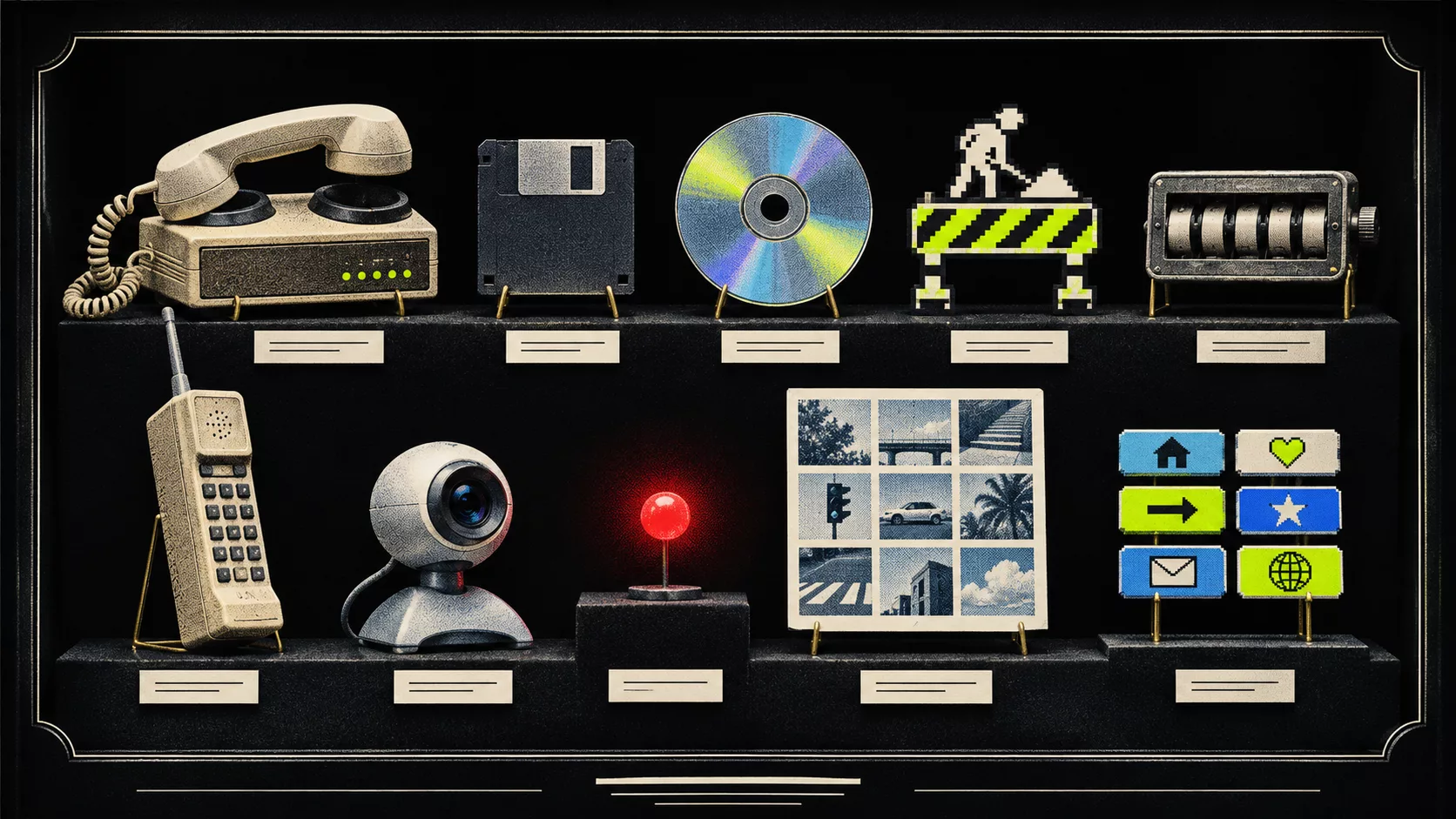
PERMANENT COLLECTION · 10 OBJECTS
The history of the network also lives inside the objects we touched, heard and forgot.
Before the cloud and borderless screens, the Internet had weight, sound and shape. These ordinary objects became fossils of a connected civilization.
01 · The Acoustic Modem
Period: 1970s. A telephone handset rested in two rubber cups. Data became sound and crossed the line like an unfamiliar voice.
02 · The 3½-Inch Floppy Disk
Period: 1980–2000. With only 1.44 MB, it carried documents, games and sometimes a virus. Its shape survives as the universal save icon.
03 · The Internet CD-ROM
Period: 1990s. Distributed in magazines and mailboxes, it offered free hours online and became a first doorway to the Internet.
04 · The “Under Construction” GIF
Period: 1995–2005. An animated worker dug forever on a page that was never finished. The Web presented itself as a collective building site.
05 · The Visitor Counter
Period: 1990s. A few digits proved that somebody, somewhere, had visited. Before invisible analytics, audiences were public and proudly displayed.
06 · The 88 × 31 Pixel Button
Period: 1996–2004. Tiny banners declared a preferred browser, a community or a friendly website: the miniature coats of arms of the independent Web.
07 · The Early Mobile Phone
Period: 2000s. Digital communication left the desk and entered every pocket.
08 · The Desktop Webcam
Period: 2000s. A small lens turned written conversation into presence and made private rooms potentially public.
09 · The Red Notification
Period: 2010–Today. A tiny circle, an urgent color and a number became enough to interrupt the physical world.
10 · The CAPTCHA
Period: 2000–Today. Distorted letters and street images ask us to prove that we are human as machines become increasingly capable.
An Internet museum preserves more than machines. It preserves the gestures, sounds and expectations they created.
A disk or drive can carry a file. From Floppy Disks to iCloud follows what happens when the same job becomes an online service.
Leave a Reply
You must be logged in to post a comment.