
← Internet History · Chapter 01
Before pages, machines had to learn how to understand one another.
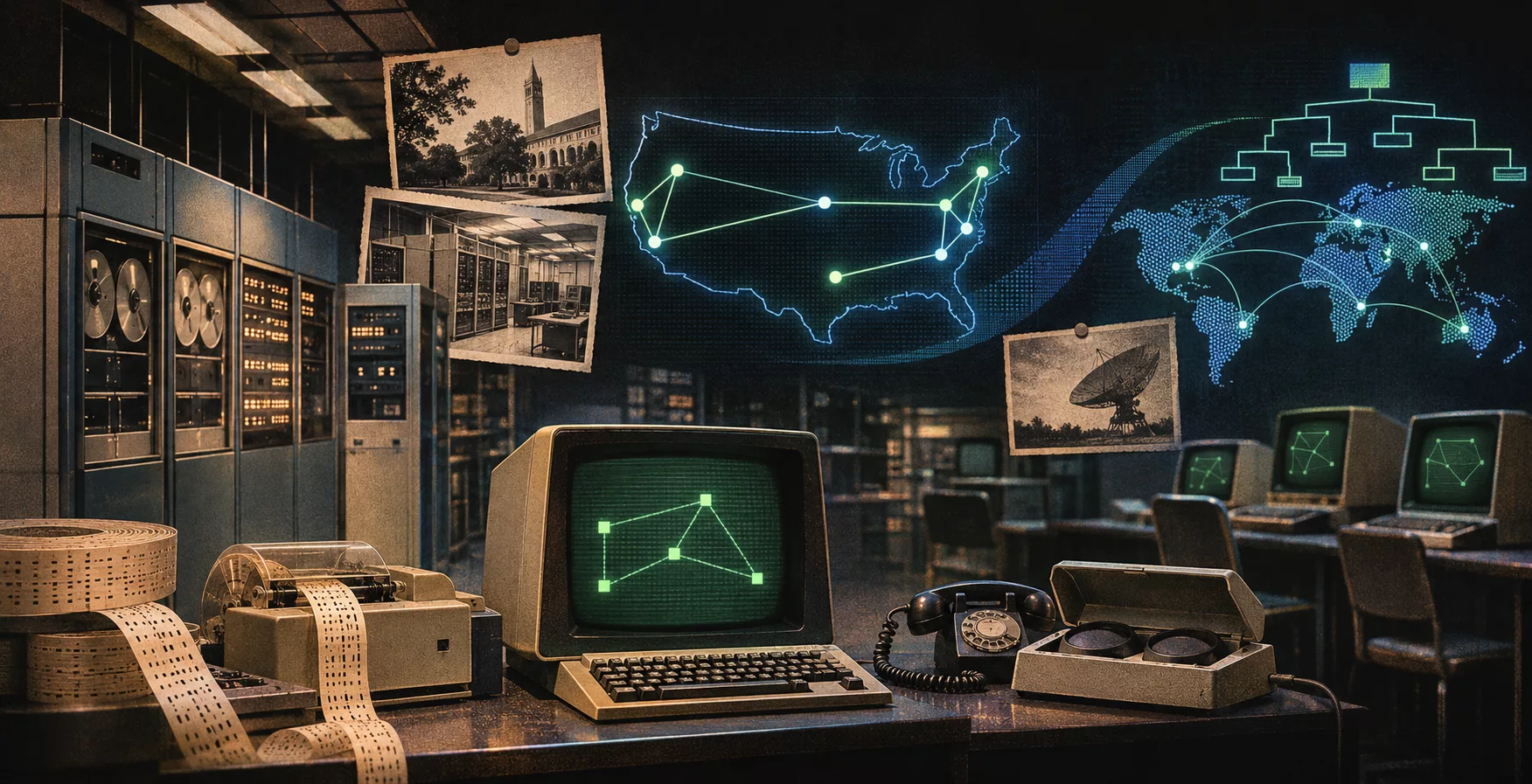
The Internet did not begin with an app, a logo or a “Like” button. It began in laboratories, among expensive computers, heavy cables and terminals that had to be shared from a distance.
1969 — The first message
On October 29, 1969, a UCLA team tried to send the word LOGIN to a computer at the Stanford Research Institute. The system crashed after the first two letters. The first network message was simply LO: brief, accidental and deeply human.
The experimental network was called ARPANET. Information was divided into packets that could travel independently and be reconstructed at their destination. A message no longer depended on one uninterrupted path.
1971 — The @ sign finds its purpose
Ray Tomlinson adapted electronic mail for connected machines and chose @ to separate a user from a host computer. A nearly forgotten keyboard character became one of digital culture’s most familiar symbols.
1983 — Networks become the Internet
The adoption of TCP/IP allowed very different networks to communicate through shared rules. The Internet was not a single place, but an agreement between machines.
Museum object: the acoustic modem
A telephone handset rested inside two rubber cups. Data became sound and crossed the line like an unfamiliar voice. Connection was slow, fragile and audible.
See how the first ARPANET message was recorded in the UCLA log reproduced by DARPA.
Leave a Reply
You must be logged in to post a comment.