
← Internet History · Chapter 02
The first website was a guide to the Web itself. It explained what the project was, where to find browser software, and how to set up a server. At a time when there were almost no other websites to visit, one of the most useful things a page could do was show its readers how to make another one. Browse CERN’s restored first website
A link to another computer
In 1989, researchers at CERN already had ways to send messages and transfer files across networks. Finding a particular document was a different problem. A colleague might know which machine held it, what software you needed to open it, and where to look once you got there. When that colleague left, some of that knowledge could leave with them.
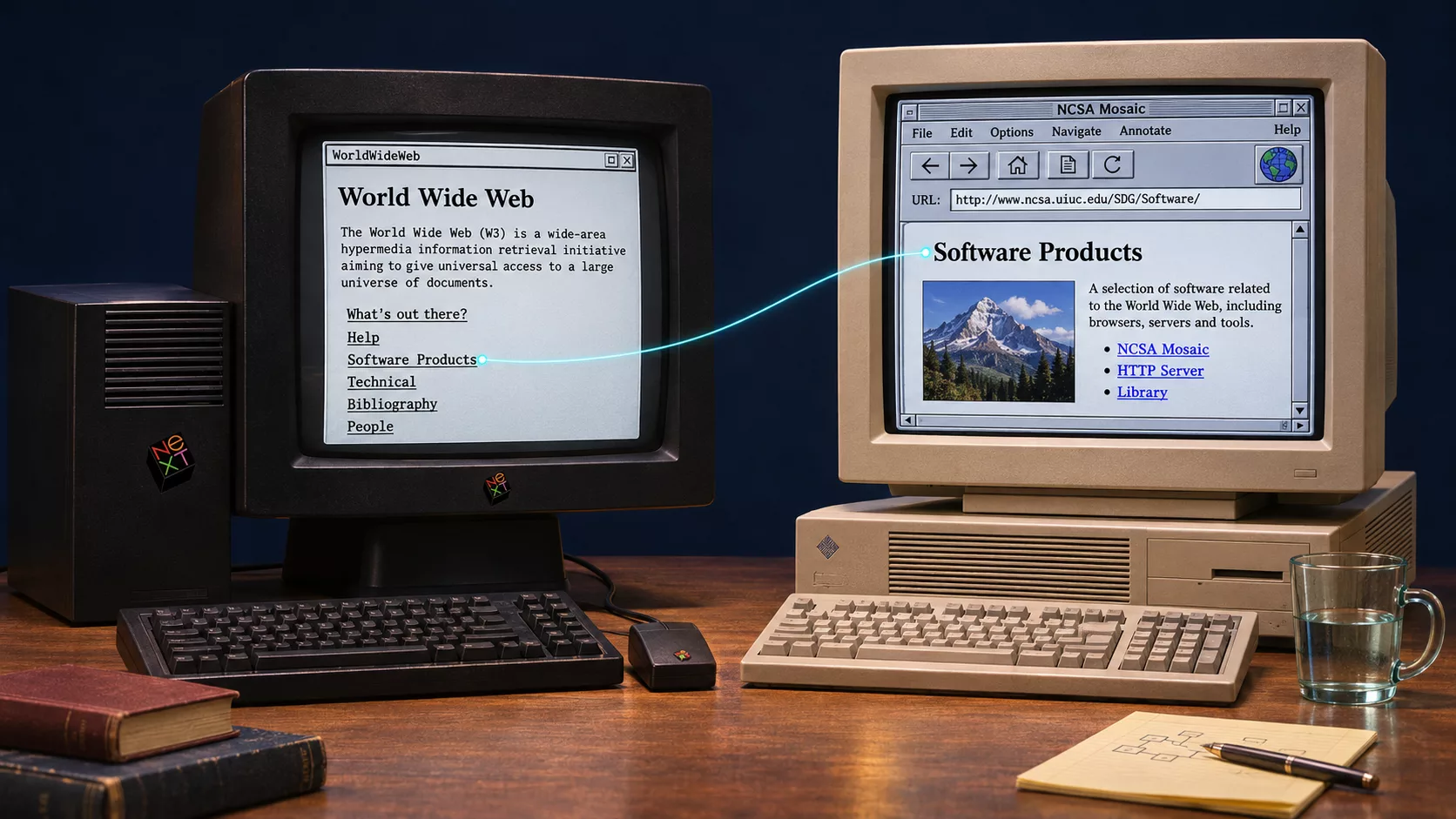
Tim Berners-Lee proposed using hypertext to connect documents across computers. A report could point directly to a reference stored on another machine. The reader could follow that link from the report itself. By the end of 1990, Berners-Lee had a browser and a server running at CERN on a NeXT computer. His browser, called WorldWideWeb, could also edit pages. The same program let you follow a link and add one of your own. CERN’s short history of the Web
What happens when you follow a link?
Take the address of that first page, https://info.cern.ch/hypertext/WWW/TheProject.html. The URL gives the browser a destination. The http at the beginning tells it how to ask for the page, info.cern.ch names the server, and the rest identifies the document. The server sends back HTML, which tells the browser how to display the page and where its links lead.
Follow one of those links and the browser makes a new request. The next document could come from the same server or from a computer across the ocean. To the reader, the action is the same. To the person writing the page, a link means they can point to a document where its author maintains it, without keeping a copy of their own. CERN’s account of the first browser, server, and Web standards
When following a link meant typing a number
The original browser ran on NeXT computers. To bring the Web to people using other machines, Nicola Pellow developed a line-mode browser that could run on a range of terminals. Its links appeared as numbers in the text. To follow one, you typed the number and pressed Enter.
In August 1991, Berners-Lee announced the Web software on Internet newsgroups. By December, a server was running at the Stanford Linear Accelerator Center in California. A system built to help researchers share information at CERN now had a foothold across the Atlantic. CERN’s history of the Web’s early rollout
A picture in the same window
In 1993, the National Center for Supercomputing Applications at the University of Illinois released Mosaic. Versions for Unix, Macintosh, and Windows brought graphical browsing to more people. Mosaic could put an image right alongside the words it illustrated. A page about a computer could show you the machine as you read about it, with a link underneath leading to its manual. Text, image, and link could work together on the same page. NCSA’s history of Mosaic · CERN’s account of Mosaic’s release
That same year, on 30 April, CERN placed its basic browser, server, and common code library in the public domain. Anyone could use and build on that software without paying CERN a royalty. A university could run its own server, a developer could write a browser, and the two could work together. CERN’s licensing history
Open the restored CERN page today and try following a link. Its plain headings and short lists still do the job. Each link gives you somewhere to go, and each page can give you another place to start. Explore the restored first website
Leave a Reply
You must be logged in to post a comment.